|
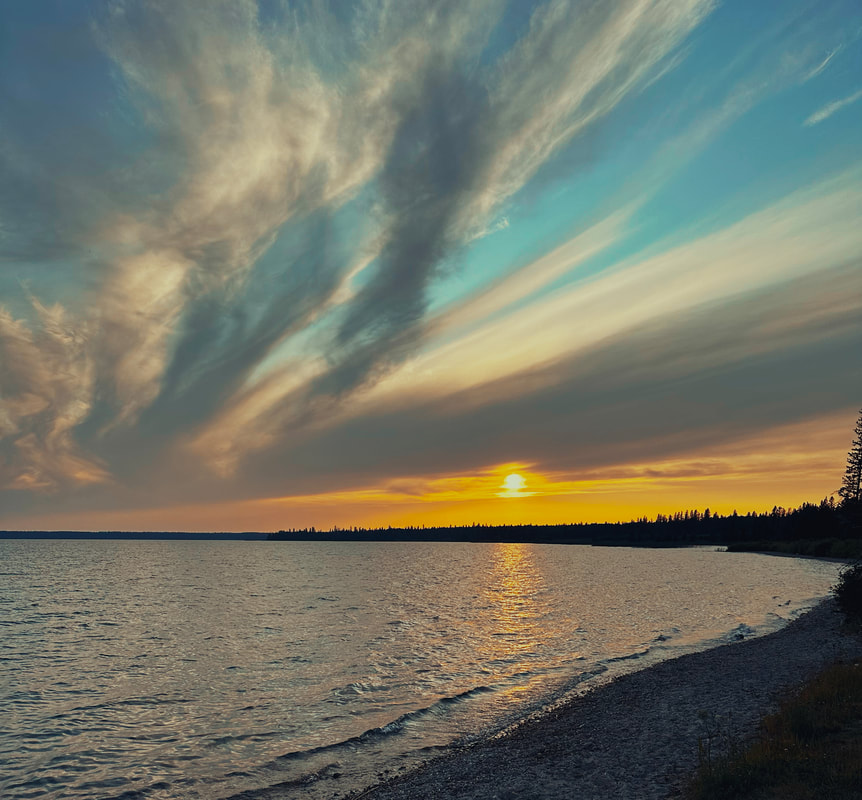
For one week every year, I get to experience a truly dark sky – a 1 or at worst a 2 on the 9-level Bortle scale. At Riding Mountain National Park, near the western edge of Manitoba in the Canadian prairie, the night sky can be so perfectly black, but so alive with glittering, colorful stars, that I can imagine what it might be like to gaze up from the surface of the Moon. Not this year. The cause: wildfires, burning with unprecedented ferocity in unusually hot, dry forests of northern Manitoba and Saskatchewan. Vast plumes of wildfire smoke have wafted south all summer, blotting out the stars (and making it painful to breathe). It’s sad to think that, just a few years ago, I never worried that smoke would keep me from using a telescope. Now, it’s a fact of life – a new reality that didn’t need to be. As a professor who often studies climate change, it's a sobering thought. Now, there were a couple nights at Riding Mountain when the wind shifted to blow from the south, holding off the worst wildfire plumes. On one of those nights, I slipped outside with my Vespera Pro. To my dismay, I could just barely make out the ribbon of the Milky Way, undulating across a sky that was far from the velvety black I’ve grown used to. What’s worse, the Vespera would not track anything. As I huddled in a shadow near our rental cottage, I tried the Trifid Nebula, then the Eagle Nebula, then the Dumbbell Nebula and the Hercules Cluster, all to no avail. It was now well past 1 AM, and I was getting desperate. Mosquitoes, no longer daunted by repeated applications of bug spray, were beginning to bite me in droves. And it was dangerous. Riding Mountain is a wild place. There are well over a thousand bears in the park, not to mention wolves, cougars, and other animals that could easily kill an amateur astronomer. I couldn’t see anything, and I imagined that every creak and crunch was animal stalking closer. Finally, I gave up. What had happened? Why did my Vespera fail now, and not in the light-polluted DC sky? Eventually, I found the reason: I had failed to input my new GPS coordinates. I’d assumed – foolishly – that the telescope automatically detected its location. Back in Winnipeg, I waited for a clear night between wildfire plumes. Finally, it came, though atmospheric transparency stayed low. I just wanted to check whether the Vespera would work when I’d entered the right coordinates. To my chagrin, it did – and I took a mediocre exposure of the Hercules Globular Cluster that was still better than anything I’d managed with another smart telescope. Any look at the Hercules Cluster – M13 – is always a little special. As I wrote several years ago, I often think of the Arecibo Message, a radio signal beamed towards M13 on November 16th, 1974. In about 25,000 years, that message will reach the approximately 500,000 stars in the cluster. Any listeners will learn about human physiology and technology – and they’ll receive a map of the solar system. In another 25,000 years, something on Earth may receive a response. Our distant descendants, I hope. In any case, after arriving home from Canada, we travelled to the coast in Delaware – another annual ritual. It’s not as dark there as it usually is in Riding Mountain (I’d give it about a 5 on that 9-level Bortle scale), but still, our beach trip is usually my next chance in the year to observe beyond our light-polluted DC skies. Readers will know that I tested the EVScope 1 and 2 during these Delaware getaways, and both had their virtues. This time, I tried the Vespera Pro, and of course I was sure to enter the right coordinates. On the final night of our stay, the sky cleared. Transparency and seeing were both about average, but the stars seemed a good deal brighter than they had in Riding Mountain. Mercifully, no wildfire smoke had made it this far south. At about 11:30, I activated the telescope just as the Andromeda Galaxy emerged out from behind a nearby building. As I reclined in a sunroom, drinking mead, I began a long exposure. A great thing about the Vespera app, Singularity, is that it works in the background while you’re checking the internet, for example, or writing an email. A less great thing, perhaps, is that there’s a mismatch between the time the telescope focuses on a target – such as the Andromeda Galaxy – and the exposure time provided by the app. I found the time was consistently about 30% off, so that a 30-minute exposure actually took 45 minutes. It’s something to consider when planning a night of observing. In any case, a 33-minute exposure of the Andromeda Galaxy yielded the following result: This is very close to the raw image. I’ve made a few small adjustments in my Pixelmator Pro software – mostly just denoising – but this is what you can expect under a suburban sky with the Vespera Pro. It is, by far, the best picture I’ve taken or anything other than the Moon. I was delighted to capture detail in Andromeda’s satellite, the dwarf elliptical M110, at the top left of the image. And just think: there are probably more than a trillion stars in this picture, shining at us with light that’s two and a half million years old. It boggles the mind. And then consider that those stars are rushing towards us at 110 kilometers per second. Someday, they might join the stars in the Milky Way to form one giant elliptical galaxy – though a recent study suggests that Andromeda might just sail past us instead. What a sight that will be. Anyway, after taking this exposure I decided to forego sleep and image my favorite deep space object: the Triangulum Galaxy. I don’t know why I love it so much. Perhaps because it’s so ignored, compared to Andromeda, despite being a gigantic star city in its own right: at 60,000 light years across, the third-largest member (by far) in our local group of galaxies. This time, I took a 30-minute exposure while downing the last of my mead. The result satisfied me even more than my shot of Andromeda. Again, I’ve done little more than eliminate a bit of noise from the following shot. To my astonishment, it’s been five years since I took my first electronically-assisted telescope – the EVScope 1 – to the beach in Delaware. It was a frightening time, for many reasons, but I still remember my delight at the blurry pictures in the telescope’s eyepiece. No, it wasn't quite the same as using my Takahashi refractors, but I felt new possibilities opening before me: the broader universe, beyond our solar system, that had previously felt just out of reach. The Vespera Pro is less expensive than the EVScope was (or than the EVScope 2 remains today). It’s worth reflecting on just how much the technology has improved. The slideshow below alternates my 2020 EVScope exposures of the Andromeda and Triangulum galaxies with the exposures I just took with the Vespera Pro. Note the much broader field of view provided by the Vespera - a must when imaging large, diffuse objects, such as nearby galaxies. It's true that you could still take better astrophotographs by making your own rig, and you could probably do it with less money. It's also true that, if I ever get around to learning how to use astrophotography software, such as PixInsight, my Vespera photographs would get that much better.
I suspect that, in another five years, electronically assisted, smart telescopes will match the performance of custom rigs - and they'll be a whole lot easier to use. Even if that never happens, it's clear that such telescopes, once widely derided as a fad, will have a place, perhaps even a dominant place, among amateur astronomy equipment.
0 Comments
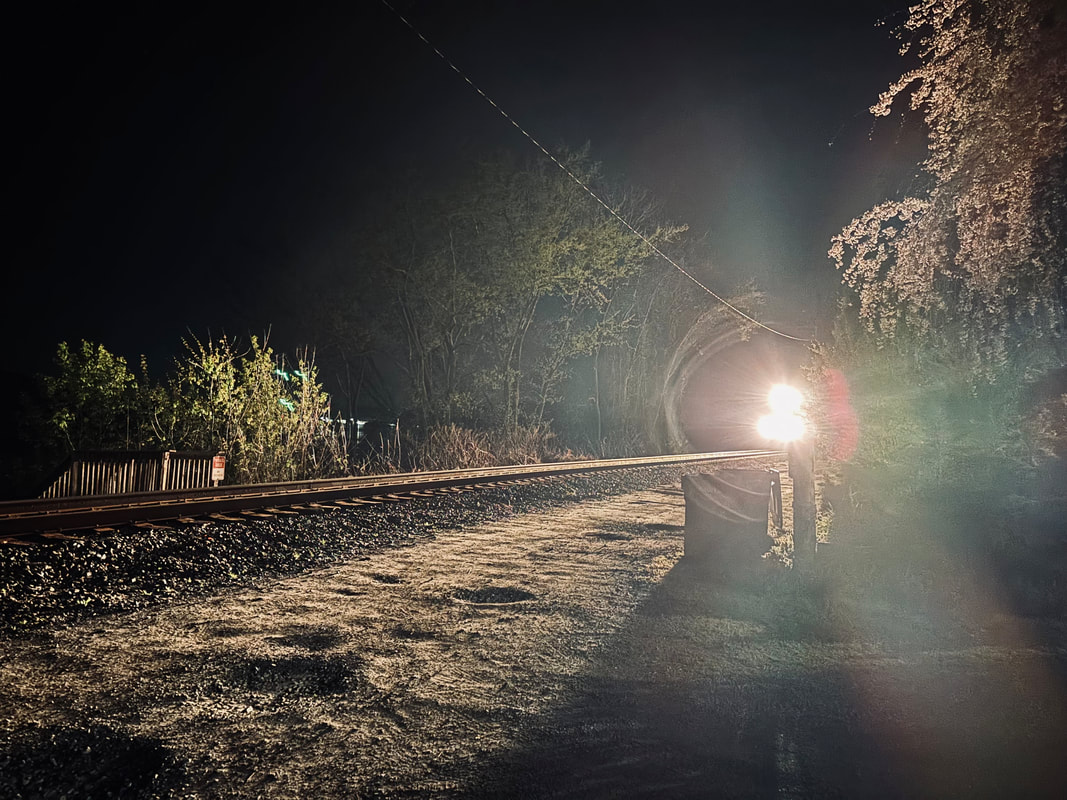
At around 10:00 PM on April 17th, I waited beside a railroad track that winds along the banks of the Susquehanna River in rural Pennsylvania. I had found a nook of open sky between trees and telephone wires, and in the darkness I could barely make out the glow of the Milky Way. I booted up a Dwarf 3 electronically assisted telescope. Readers will know that I’ve tried the EVScope 1 and 2, and then the Vespera 2. The Dwarf 3 is more compact than those telescopes, it’s much cheaper, and it promises comparable performance to the Vespera. I had to try it out. As I waited, a distant rumbling intruded on my thoughts. It occurred to me that the rumbling might have started some time ago. The ground began to tremble, ever so slightly. And then a shaft of blinding light slashed through the night. I grabbed my telescope, halfway through its exposure, and ran. I made it to the front yard of my cottage, about 15 feet from the tracks, when a freight train thundered by. Car after car after car passed as I stood, gawking. Then it was gone, and darkness returned. It took me a while to regain the courage I needed to set up the telescope a second time. Since there was still no better place to observe than beside that railroad track, I tried again. I attempted two ten-minute exposures, one of Bode’s Galaxy (M81), the other of the M3 globular cluster. Both were high in the sky. I didn’t dare stay out any longer, and when I packed up, I counted myself lucky to have avoided a second train. These are the images that I acquired at such peril: Now, the beauty of the Dwarf is that its images are saved as .TIFF files that can be easily modified and improved through astrophotography software, namely PixInsight. I don’t know how to use that program yet, but I do have some familiarity with Pixelmator Pro, a less powerful tool that I use in my scholarship. De-noising my M3 image and reducing the saturation of its green light gave me the following: Okay . . . nothing to write home about. I know for sure that it’s easy to improve some of the problems in this picture, namely the star trailing caused by inadequate tracking. But I also think that the small aperture of the Dwarf 3 – just 25 millimeters! – may add more noise to its images, and no doubt requires longer exposures to bring out subtle details in nebulae or galaxies. I was impressed by the Dwarf’s software, which is incredibly easy to use, but my first experience with the telescope underwhelmed me. I had sold my Vespera to try the Dwarf 3, and now I can’t say I was very happy about the swap. Fortunately, I found a second-hand Vespera Pro on sale for a fair price. I decided to get that telescope, and sell the Dwarf, admittedly before I had a chance to experiment with that telescope’s full abilities. A few days ago, on June 25th, I stepped out with the Vespera under the considerably more light-polluted skies of downtown Washington, DC. Atmospheric seeing was superb – maybe the best we’ve had this year – but transparency was poor. Aerosols in the atmosphere amplified the light pollution, especially in the southern half of the sky. Nevertheless, I pointed the Vespera at a patch of grey, near the galactic core, and began to observe the Eagle Nebula (M16). Here’s the result of another ten-minute exposure, again denoised with Pixelmator Pro: As you can see . . . there’s a difference. The Vespera is bulkier than the Dwarf but much smaller than the EVScope, and on some objects aperture does make a difference. A ten-minute exposure of the Whirlpool Galaxy (M51) in the light-polluted sky, for example, didn’t look quite as good as the images I’d acquired with my EVScope 2: And then there’s the setup time. The Dwarf and EVScope are ready to go within a minute or two after setup. The Vespera requires about five minutes. Then again, it tracks stars more effectively than the other telescopes, and it focuses automatically. So, on most objects, I judge the Vespera Pro to be the best electronically assisted telescope on the market – and I’m not sure it’s close.
My plan now is to try the Vespera next month under the truly pitch-black skies of Riding Mountain National Park, Manitoba. With any luck, there won’t be much wildfire smoke in the atmosphere, and I won’t be attacked by a cougar or coyote. We’ll see! |
Archives
November 2025
Categories
All
|


RSS Feed